56 Walls That Stand Between Women and Leadership
It's been five years since I founded Flora in Japan - five years in the consumer business and over three in enterprise - and it's the enterprise side I want to focus on today.
We've sold our platform to Big Corps, to SMEs, local banks, sports associations, sometimes even local governments. I've pitched it as a healthcare service, as a medical fee reduction scheme, as a way to get certifications from the government, or to improve employee engagement and retention, to hire more women - lots of different angles for different policy goals and KPIs.
At some places, not as often as before but still not that rarely, we are met with a deep-rooted scepticism about anything targeting women in particular. At other places, HRs or other departments get very defensive, insisting their system is gender-neutral and that whatever outcome it produces is based solely on merit. Then, we have also been told that the small ratio of female managers in Japan is a temporary problem, which will be solved on its own when the current generation matures into higher positions.
I find it very surprising (in a bad way) that for all of the seriousness of the gender gap issue in Japan - considering its aging workforce, acute labor shortage, low fertility rate - there's a general lack of data and lack of comprehensive understanding on the part of the stakeholders (CEOs, CHROs, politicians, HRs, etc) of why so few women become or even want to become managers, why it is an actual problem and what advantages a diverse workforce brings.
Many HRs find it their duty to protect the status quo of gender-neutrality and alleged meritocracy in the workplace, and it escapes them that the language they speak is the language of feelings and emotions. It is also true that unfortunately, many ventures, consultancies and activists focusing on gender gap issues use a similar language of moral duty and feelings. Very few people talk about data, and there's a lot of noise on both sides.
I think that the way we have these conversations needs to be reframed. We need a clear data-driven framework that serves as a common language for the many stakeholders to focus on identifying and solving real problems in the workplace. This is what this article is about.
There are very few companies out there that have the same amount of data on women's health combined with work performance that Flora has - 150 enterprises with over 200,000 employees combined on a multi-year basis. The sheer amount of data helped our team led by Takada COO to create a fairly comprehensive model that we think can be applied to every workplace in Japan - the "56 Walls" model - called so after the 56 barriers standing between female employees and leadership. Crucially, the model rests on data rather than impressions - across these enterprises we can hold personality, age, and tenure constant and still watch the structural gap persist.
Before explaining the model, I want to make the premise clear: workplaces in Japan (and around the world, for that matter - though today I focus mainly on Japan) have been crafted around the imaginary "standard worker": a breadwinning male who can work long hours, at any given time, because he has a partner at home who takes care of every other aspect of life [1]. This "standard" is not true for most women, and it's increasingly untrue for men as well.
Japan has recently seen a wave of initiatives - parental leave promotion, caretaker support, diversity training - but most of these stop at awareness. They don't reach performance reviews, promotion criteria, or job assignments - the parts of the HR system that actually determine careers. Why that keeps happening is a data problem, and it's something I want to write about separately.
So that's the premise: the system was built around this "standard". The 56 Walls model maps where and how it fails everyone else.
The Model
Wall dimension
The 56 Walls model maps these barriers across two axes: 6 dimensions (what kind of barrier it is) and 3 career phases (when it hits hardest).
Let me start with the dimensions.
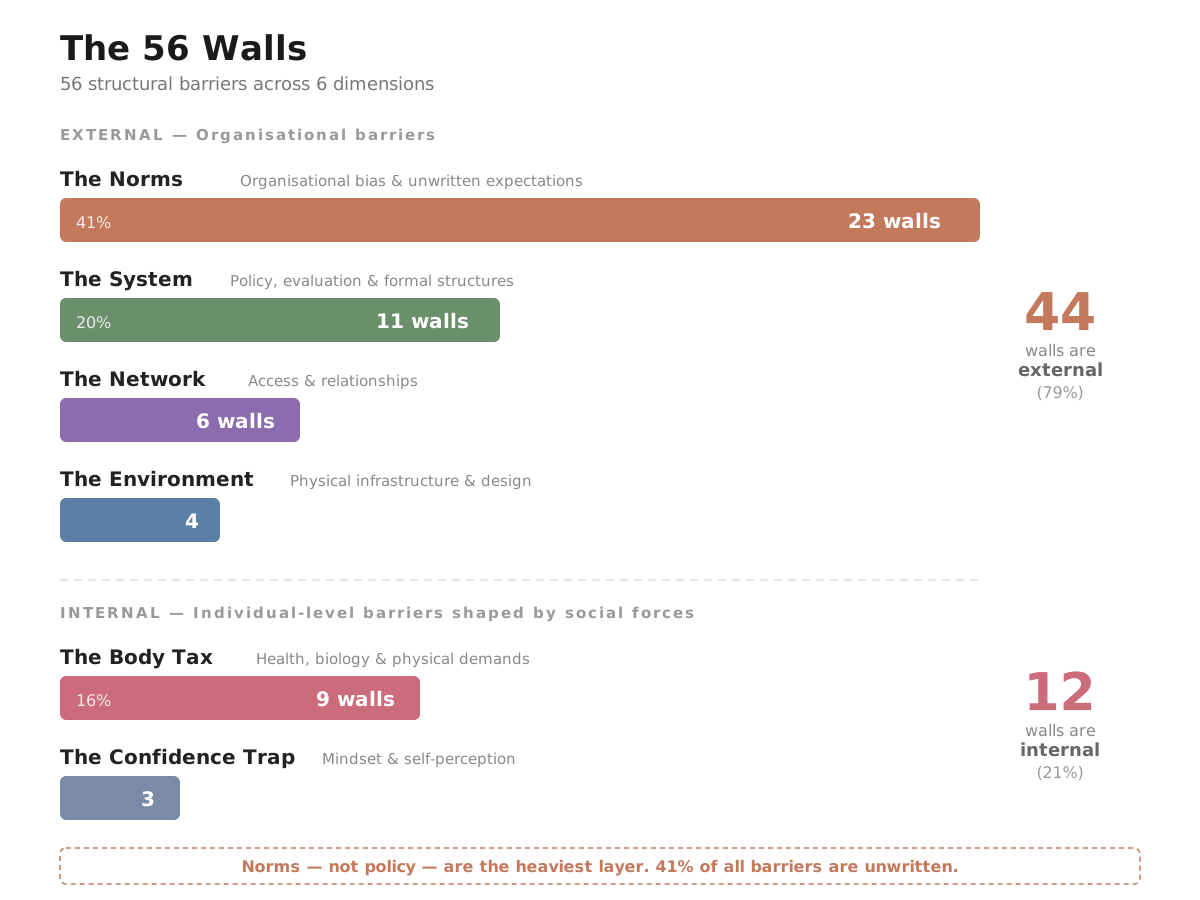
The first thing to notice is the split between external and internal. External means it's the organization's problem - the way systems, rules, infrastructure, and culture are set up. Internal means it shows up inside the individual - her confidence, her health, her sense of what's possible. As seen in the picture, 44 of the 56 walls are external, that's 79% versus 21%.
Most of the initiatives for closing the gender gap - role model seminars, confidence workshops, infertility benefits - focus on these 21%, on the internal walls. Without a doubt, these are important problems, but it leaves the majority of barriers untouched.
Now, the 6 dimensions themselves:
The Norms (23 walls - 41%) is the heaviest layer by far. These are biases, norms, and unwritten expectations that exist in every organization but appear in no policy document. To be clear, we focus on the norms in a narrow sense, the unwritten rules of the company that can be addressed by the HRs.
For example, a mother isn't assigned to a demanding project "out of consideration" - but as a result she's denied exactly the experience she needs for her next promotion. Invisible work like meeting notes, onboarding new hires, and office housekeeping falls disproportionately on women [2], yet is only partially reflected in performance reviews.
And of course, an important factor is that outside work, women in Japan still spend roughly five times as much time on unpaid domestic and care work as men do - the widest gap in the OECD [3]. One can argue that it is not the job of HRs to address the gender division of labor and we have to partially concede. Nevertheless, initiatives like parental leave promotion for male employees can tangibly move the needle here.
The System (11 walls) is the formal rules - evaluation criteria, working hours, promotion timelines.
Even now, performance reviews reward long hours and constant availability. Promotion in most companies is decided around age 35 - exactly when women are having children. Parental leave exists, but using it marks you; there's even a word for the career path afterward: the mommy track. The conversation around maternity leave is changing - many women now return to work, and the M-curve has flattened considerably [4]. But the system around it hasn't really changed.
In one regional bank we benchmarked (around 2,000 employees), one of the surprise findings was that of the around 60 women who had reached management, not one had taken maternity or childcare leave [5].
One of the most frequent objections - "our system is gender-neutral, outcomes are pure merit" - tends to not survive the data: at another bank, women's performance ratings were equal to or slightly higher than men's, yet even after controlling for 30 personality traits, age, and tenure, women sat about 4–5 grade ranks and ¥150,000 a month lower.
Unfortunately, if there are gaps in the system itself, it means that the idea that gender gap is a generational lag that will sort itself out is too optimistic. The situation will hardly change unless we learn how to correct the system.
The Body Tax (9 walls) is what it costs to work in a system that treats the male body as the default. Menstrual symptoms, pregnancy, postpartum recovery, and menopause are not accounted for in the workplace. In the bank we benchmarked, the rate of long-term sick leave among female permanent employees was 2.5 times that of men - and among employees in their 30s, 3.7 times higher [5]. That burden peaks at precisely the childbearing-and-career-building years, on top of everything else stacking up in that decade.
An estimated 460,000 women in Japan have left their jobs because of menopause symptoms [6] - and that hits at the exact career stage when women are expected to step into senior leadership. Infertility treatment requires unpredictable schedules and frequent clinic visits, but disclosing it feels risky, so women handle it in silence until they burn out or quit. Some 62% of women of reproductive age are affected by gynecological conditions [7], yet OB/GYN screening is optional in most company health plans. And although a growing body of research demonstrates biological sex differences at the cellular level [8], many workplace health policies remain built on a "one-size-fits-all" model - neglecting sex-specific needs, for women and for men too, who face conditions such as andropause and prostate cancer.
The Network (6 walls) is about who has access to information and relationships. This networking often happens at the smoking area, on the golf course, or over after-work drinks. For women who have families, weekly golf outings and drinks are a trade-off between promotion opportunities and caretaking responsibilities.
I remember having an honest talk with a female employee at a smaller bank in the Chugoku region when I asked her about her career aspirations. She told me that to become a branch manager she'd have to play golf every weekend - and that, for her, simply wasn't compatible with being a mother.
The Environment (4 walls) is the most physical layer. There are still construction companies that don't have female toilets on-site, so women have to go to nearby convenience stores. Protective equipment in industrial environments has traditionally been designed around male-sized hands, heads, and feet [1], often leaving women with poorly fitting gear - a safety concern that the industry is only beginning to address.
The Confidence Trap (3 walls) covers psychological barriers: impostor syndrome, the ambition gap, and internalised self-doubt that accumulates over a career. Women who reach senior positions often report difficulty attributing success to their own competence, and longitudinal data shows leadership motivation declining over time despite equal starting levels [9]. At 3 out of 56, it is the smallest category in the model.
Timing
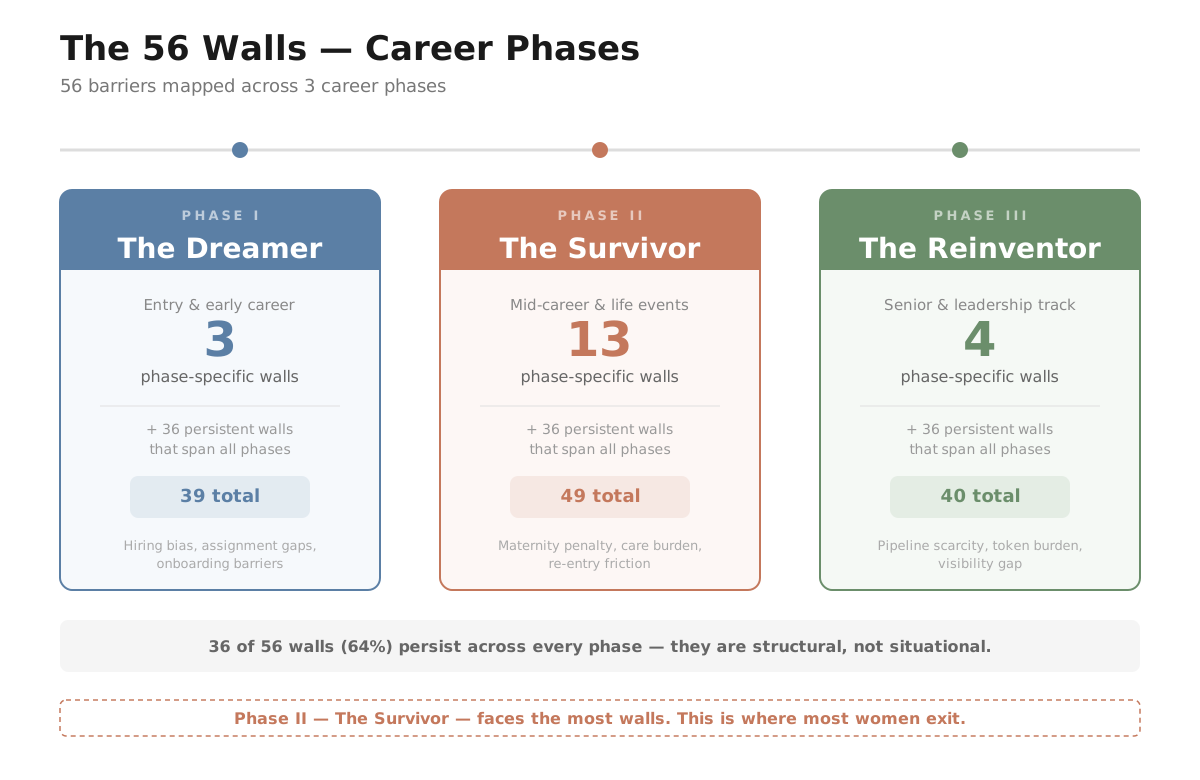
The second axis is timing. Not all 56 walls hit at the same career stage, so we mapped them across 3 phases, a framing that builds on established career-development research [10]. 36 walls exist across all phases.
The Dreamer (Phase I) is early career - full of ambition, believing hard work will be rewarded equally. 3 walls are specific to this phase, but combined with the 36 that persist across all phases, there are already 39 barriers on day one.
The Survivor (Phase II) is where the model gets heavy. 13 phase-specific walls pile on top of the 36 persistent ones, with 49 total. This is mid-career, when promotion timing collides with pregnancy, childcare, and sometimes fertility treatment. Most women who leave, leave here.
The Reinventor (Phase III) is senior leadership. 4 phase-specific walls bring the total to 40. At this stage, barriers shift in character. Double-bind dynamics emerge - decisiveness risks being read as aggression, while a collaborative style risks being read as lacking authority [11]. This career stage also coincides with perimenopause and menopause for many women, meaning peak professional demands overlap with significant physiological change.
Now What?
So, now what? In management, a framework is useful only if it can help you navigate complex decision-making, it is not simply a research tool.
The first way 56 Walls model can be used is diagnosis, which means working out which of the walls are genuinely present in a given organization instead of assuming that every company has the same ones. The second is evaluation, where we measure how high each wall stands and how many women it affects. The third is benchmarking, which lets a company see honestly where it sits compared to others of a similar industry and size. And the fourth is prioritization, because nobody can take down 56 walls at once, and the data tells us which ones are doing the most damage and therefore deserve attention first.
With data on more than 150 enterprises and counting, the model stops being only a way to describe the present and starts becoming a way to predict future change. We can begin to simulate how a specific policy would move the numbers that companies genuinely care about, whether that is retention, ambition, engagement, or the female manager ratio itself. Rather than launching an initiative and simply hoping it works, a company will be able to estimate its likely impact before it spends a single yen. That is what Flora is building and that is why filling the model with real data and applying it is the hardest and most important part.
Takeaways
Our model isn't that simple, but I believe it shouldn't be - the issue of women and leadership is a complex one involving healthcare, cultural norms, and infrastructure; it cannot be reduced to a 4x4 matrix.
To sum up, there are 3 takeaways I'd like the reader to have from this article:
- If your diversity strategy is training and awareness, you're working on 21% of the problem. The other 79% is in your systems, your norms, your infrastructure and it remains unaddressed.
- You probably already know your female manager ratio, but do you know why your employees don't get or don't want to get promoted? Similar to other departments, your HR policies cannot be based on feeling and norms, they should be about harnessing data to reduce inefficiency, to strengthen hiring, to increase productivity and to empower every worker. Without this approach, every initiative you have is a guess.
- The biggest talent leak isn't at the top - it's at the first promotion. Instead of the "glass ceiling", the phrase "broken rung" is more appropriate: plenty of women at the bottom and in junior roles, then the ladder is broken in the middle, at the step into section chief and manager - so only a handful ever reaches the top. By the time you're hunting for female executives, the pipeline is already empty.
The standard worker was an invention - and anything invented can be redesigned. That's the work we do at Flora: helping companies see their own walls clearly, then take them down one at a time. If this made you wonder which walls are standing in your organization, I'd genuinely like to hear from you - write to me directly at anna@floramaternity.com.
References
1. Criado Perez, C. (2019). Invisible Women: Exposing Data Bias in a World Designed for Men. Chatto & Windus.
2. McKinsey & Company & LeanIn.Org (2015-2024). Women in the Workplace. Annual report series.
3. OECD (2021). Balancing Paid Work, Unpaid Work and Leisure. OECD Gender Data Portal.
4. Cabinet Office, Government of Japan (2023). White Paper on Gender Equality 2023 [男女共同参画白書].
5. Flora Co., Ltd. (2026). Enterprise Wellbeing and HR Analytics Dataset (150 enterprises, 200,000+ employees, 2021–2026).
6. NHK (2021). 更年期症状と仕事に関する調査 [Survey on Menopausal Symptoms and Work].
7. Global Burden of Disease Study (2021). Global prevalence and trends of gynecological diseases among women of childbearing age, 1990–2021. PLOS One.
8. Clayton, J. A., & Collins, F. S. (2014). Policy: NIH to balance sex in cell and animal studies. Nature, 509(7500), 282–283.
9. BCG (2017). Dispelling the Myths of the Gender "Ambition Gap." Boston Consulting Group.
10. O'Neil, D. A., & Bilimoria, D. (2005). Women's Career Development Phases: Idealism, Endurance, and Reinvention. Career Development International, 10(3), 168-193.
11. Eagly, A. H., & Carli, L. L. (2007). Through the Labyrinth: The Truth About How Women Become Leaders. Harvard Business School Press.